Image

 Consumer Health
In Double Take, a primary care provider and a specialist team up to answer your health questions — from prevention to treatment and everything in between.
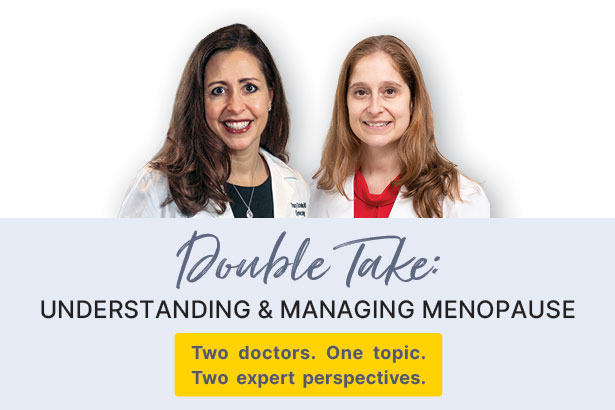
Menopause looks different for every woman—and it’s about far more than hot flashes. In this Double Take, two Englewood Health experts share their perspectives on recognizing symptoms, understanding treatment options, and navigating this transition with confidence.
Michelle Graziano, MD, Primary Care: Hot flashes are common, but menopause often affects much more than body temperature. Women may notice sleep disturbances or changes in sleep quality, mood changes such as depression or anxiety, and over time, vaginal dryness. Many also report “brain fog,” joint or muscle achiness, and changes to their skin and hair. These symptoms can appear gradually and vary widely from person to person.
Dr. Graziano: It can be challenging because these symptoms can have many causes. I start with a detailed history and often order basic blood work to rule out other medical conditions. Menopause is largely a clinical diagnosis, meaning there’s not a lab test or other test to confirm it. So, understanding a patient’s symptoms, age, and overall health picture is essential.
Dr. Graziano: Yes — and even simple changes can make a meaningful difference. Dressing in layers can help manage sudden temperature changes, and avoiding common hot flash triggers like alcohol, hot beverages, and spicy foods can reduce symptoms. Good sleep habits are key. Many women also benefit from relaxation techniques, yoga, cognitive behavioral therapy, or aromatherapy to help manage stress related to menopause.
Dr. Graziano: Many non-hormonal prescription options can be discussed in primary care. If those approaches aren’t effective, or if a woman is specifically interested in hormone replacement therapy, referral to a gynecologist for further evaluation and discussion is appropriate.

Tracy Scheller, MD, Gynecology: The five to ten years when women experience perimenopausal symptoms is a critical time to discuss hormone therapy. For most women, this is in their mid-40s, but anywhere from the early 40s to late 40s is common. Declining estrogen can lead to bone loss and changes in blood vessels that affect heart health. Addressing symptoms and risks during this window can have long-term health benefits.
Dr. Scheller: I focus on understanding each patient’s personal risk factors, including a history of blood clots, migraines with aura, cancer, or cardiovascular disease. Once we understand individual risk, we discuss the benefits of HRT. The hormones we prescribe today differ from the synthetic hormones (Premarin and Provera) studied in earlier trials. Today’s therapies are associated with lower risks of blood clots and breast cancer and can improve bone density and heart health in appropriate patients.
Dr. Scheller: In addition to being a gynecologist, I’m the medical director at the Graf Center for Integrative Medicine at Englewood Health. Here, we emphasize lifestyle consistency and offer supportive therapies like acupuncture, massage, Reiki, nutrition counseling, and supplement guidance to help women manage symptoms and maintain long-term wellness throughout menopause and beyond.
If you’re experiencing symptoms like sleep changes, mood shifts, hot flashes, or brain fog—or have questions about menopause treatment options—Englewood Health physicians can help.
Posted on February 10, 2026