Image

The information on this page will help you understand what you can expect if you or a loved one is hospitalized at Englewood Hospital.
In certain circumstances, our staff might identify that patients need “close observation” during a hospital stay. Such reasons may include an increased potential to:
We are committed to providing the appropriate level of care for such patients through close observation by a specially trained patient care associate. A family member is always welcome, regardless of whether or not a patient requires close observation, but a family member is not a substitute for trained personnel in order to ensure safety.
When it’s time to leave the hospital, your nurse will provide you with a discharge summary and instructions. This will include information about your after-hospital plan of care, medications, and follow-up appointments. Please be sure to ask any questions you have.
If you need a visiting nurse, home health care, or special equipment to help you recover, your care coordinator or social worker will help you.
Medicare Notices and Appeals
If you are a Medicare inpatient, you will be given information about your discharge rights. If you think you are being discharged too soon, you may exercise your right to request an appeal by a Quality Improvement Organization. The contact information for the QIO is:
Livanta
866-815-5440
Your case coordinator can provide you with more detailed information on this appeal process.
Conflicts and Ethics Disputes
Family members, patients, and the care team may have a difference of opinion regarding the goals of care. We encourage patients and families to have an open dialogue with the care team members by requesting a patient and family conference to attempt to reach agreement on the goals of care.
For circumstances in which a patient/family care conference fails to resolve a complex ethical issue, the hospital provides the services of an ethics committee, which can create a mechanism for conflict resolution through communication and shared decision making. A family member or patient representative can speak to the nurse manager or nurse supervisor for further assistance.
Pain is an individual experience. Managing the pain that you experience takes communication and teamwork between you and your healthcare providers. We are committed to always providing our patients with optimal pain management at all stages of their care.
What is Pain?
Pain is a physical discomfort or suffering caused by illness or injury. Each person’s pain is unique. It is affected by your physical condition, past experiences, and your attitudes and emotions. You may not describe or experience pain in the same way as another person with the same condition. Our team recognizes that your pain is what you feel it is.
Why is it Important to Control Pain?
Our goal is to help return you to your activities of daily living. Pain can affect your activity, mood, sleep, energy, and relationships. It is important to control pain to prevent suffering and allow for faster recovery. The goal is to help control the pain, but not have it completely go away. This is because pain can help guide you in the recovery process to allow you not to overwork yourself.
How Can You Inform Your Care Team of Your Pain?
If you are experiencing pain, inform your care team at the onset of your pain. Use these questions to help describe your pain:
How Much Does Your Pain Hurt?
Our team will routinely ask your pain level to help us evaluate if your pain is adequately managed and how best to control it. You will be asked throughout your hospital stay to rate your pain on a scale of 0 to 10. (0 = No Pain and 10 = the worst pain you can imagine or have ever experienced.)
Pain Management That is Centered Around the Patient
Our multidisciplinary pain management team is trained in the most current techniques for managing pain. The team’s board-certified pain management physicians and nurse practitioners work closely with your medical and surgical, anesthesiology, nursing, and rehabilitation teams to ensure that any pain you may experience is appropriately controlled during your recovery. The focus of our care is centered around you, the patient.
Treating Your Pain
Englewood Hospital’s team will create an individualized plan to treat your pain based on your needs and preferences, and aligned with specific goals for your recovery.
Taking an Active Role in Your Pain Management
Patients play an important role in effective pain management. You can help improve your pain by:
Inpatient Meals
Our dining team, led by a chef trained at the Culinary Institute of America, strives to provide you with healthy and appetizing meals throughout your stay. Registered dietitians will work with your physician to tailor your meals and provide nutrition counseling. Please advise us of any cultural or religious needs you may have that require our attention.
For food-related requests, call 201-894-3097. During off hours, the nursing team can assist you with these requests.
Dining Options for Visitors
Visitors can enjoy the Drapkin Family Café, which offers a wide selection of food and snacks on the main floor. Vending machines are conveniently located throughout the hospital in the lounges on each patient care unit. There is also a larger bank of vending machines on the first floor.
Bringing Your Own Medication from Home
Please inform us if you have brought any medications from home.
For your safety, and to reduce the possibility of overmedication and/or adverse drug interactions, your own pre-hospitalization medication must be sent home with a family member and must not be brought back to the hospital, unless there is a specific written order. If the medication cannot be sent home, then it will be sent to the pharmacy for safe keeping.
In certain cases, it may be necessary to use your own medication during your stay. Your medication will be identified and labeled properly by a pharmacist and maintained by your nurse, who shall administer it at the appropriate times. Your healthcare team will check your ID bracelet before administering your medication.
If at any time during your stay you would like to speak to a pharmacist about medicine you are being given, ask your nurse to contact the pharmacy.
Medication Counseling
Before giving you any new medication, your nurse, physician, or pharmacist will explain what the medication is for and describe possible side effects. You or a family member will also be given a printout with information about your medication. Let your doctors know if you feel like you are experiencing any side effects.
Before leaving the hospital, it is important to understand your discharge medication list. Your healthcare provider will tell you the brand name, generic name, dose, what the medication is for, when you should take it, and what to do if you notice any of the possible side effects. Ask any questions you have about your medications, or request to speak with a pharmacist before discharge.
Fill your new prescriptions on your way home so that you will have them available for your next dose.
Know Your Medications
While you are in the hospital, make sure you know what medications you are taking and why you are taking them. Here are some questions to ask:
People sometimes misuse opioid pain medications (painkillers), either by taking them in ways they weren’t prescribed or by taking someone else’s prescription. One in four overdose deaths involve prescribed opioid painkillers. Our emergency department will only provide pain relief options that are safe and appropriate for you.
For your safety, we will:
We do not:
PRESCRIPTION OPIOID PAINKILLERS CAN BE JUST AS DANGEROUS AS ILLEGAL DRUGS.
KEEP YOUR PRESCRIPTION OPIOID PAINKILLERS SAFE!
An important mission of our hospital library is to provide patients and their families with information about their health condition. Material can be delivered to your hospital room. To request information from the medical library, call 201-894-3069 during normal business hours. In addition, in some patient care units a computer is available for research.
Clean hands count! Most germs that cause serious infections in healthcare are spread by people's actions. Patients are at risk for getting an infection while being treated for something else. Clean hands can prevent infections. Ask your healthcare providers for clean hands.
Read more helpful tips from the Centers for Disease Control and Prevention (CDC) on ways to prevent getting an infection in the hospital.
Families or patients may wish to hire the services of a private duty aide. Private duty aides may be beneficial to patients with high anxiety, who may need additional support to cope with their hospital stay.
Private duty aides are permitted in every unit except the intensive care units. Payment is the responsibility of the patient or family. Please check with your insurance plan to see what expenses are covered.
For more information on private duty aides, including a list of agencies that offer such services, please contact our Care Coordination Department, 201-894-3080, or speak to a nursing supervisor outside of business hours.
Patients and families may call for immediate help in cases of emergency or if they have serious concerns about a patient’s condition. This is called a “Condition H.” A patient or family member can call a Condition H if, after speaking with a nurse, physician, or other member of the healthcare team, you continue to have serious concerns, such as a noticeable medical change, uncontrolled bleeding, unresponsiveness, or severe difficulty breathing.
To Activate a Rapid Response (Condition H):
We offer services and amenities to accommodate the religious needs of patients and families. Some of these amenities include access to:
Religious holidays are also observed through appropriate ceremony, and services are televised onto the patient televisions. A chapel is located on the main floor of the hospital.
For more information about religious services and amenities, call our Pastoral Care Department at 201-894-3228. On weekends and evenings/nights, please speak with a nurse.
During your stay, you may meet a number of healthcare professionals who work together to coordinate your care. We encourage you to speak up, ask questions, and let your needs and concerns be known. Here are some common healthcare professionals who will help care for you during your stay.
Physician
The physician in charge of coordinating and delivering your care is called the attending physician. This may be your primary care physician, one of our hospitalists, or another doctor assigned to you. A hospitalist is a physician who specializes in the care of hospitalized patients. You may also be seen by other medical or surgical specialists, as well as by residents, physician assistants, and advanced practice nurses. Residents are physicians who are in training programs for a particular specialty.
Nursing Team
In each patient care unit, the staff is led by a nurse manager (a registered nurse who is responsible for supervising patient care, and coordinating other registered nurses and all nursing and support staff on the unit). Nursing staff functions on a 24/7 basis; nursing supervisors during the evenings, nights, and weekends/holidays have managerial oversight for the entire hospital.
A registered nurse (RN) is designated as your primary nurse. He or she plans and coordinates your overall plan of care along with your physician and other members of your care team. The RN also assigns tasks to the patient care associates and patient care technicians (PCAs/PCTs).
Allied Health Professionals
Physical therapists, occupational therapists, respiratory therapists, speech pathologists, audiologists, and other therapists may work with you, your family, and your medical team to help meet recovery goals.
Case Coordinator and Social Worker
Case coordinators and social workers will assist you and your family with planning for your needs when you leave the hospital.
Pharmacist
A pharmacist is responsible for reviewing each medication ordered in the hospital and making sure the dose, route, and schedule are the best possible for you. Our pharmacists work very closely with your other healthcare providers to make sure you are getting great care, and to reduce the chance of having side effects from your medication.
If you would like to talk to a pharmacist about your medication, ask your nurse to contact the pharmacy. Pharmacists may also stop by to talk to you about new medications and changes in your home medications before your discharge.
Dietitian
A registered dietitian will review your medical record and work with your healthcare team to develop a nutrition care plan for you. Registered dietitians provide nutrition education and diet instruction about any diet you may need to follow after you are discharged. A nutrition assistant will help you order meals and assist with tray delivery, along with the dietary worker.
Housekeeper
A housekeeper specially trained in hospital sanitation cleans your room every day. If your room needs attention at any time in between normal cleanings, call the Environmental Services Department at 201-894-3035.
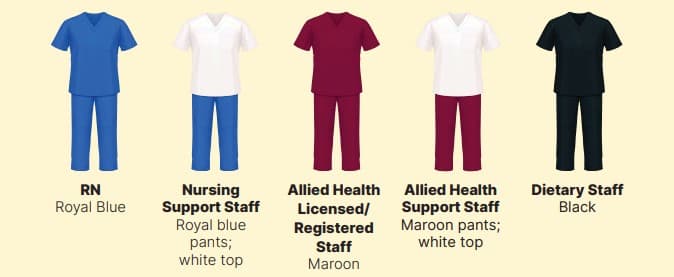
To help you easily identify the role of people on your care team, our uniforms are color-coded. Here are some of the common uniforms and colors you will see.
Room Assignments
Rooms are assigned based on medical need and available space. Two types of rooms are available: private (single accommodation) and semiprivate (double).
Private rooms: To request a private room, please speak with your nurse or call Patient Access Services at 201-894-3015. Private rooms are billed at a higher cost and the difference is usually not covered by insurance.
Your room number is posted in your room so that you can provide this information to your family and friends. For your privacy, your room number will not be given out to anyone calling the hospital.
Housekeeping (Environmental Services)
We are committed to keeping your room clean at all times. A member of our environmental services team cleans your room every day. If your room needs attention at any time in between normal cleanings, call 201-894-3035.
TV, Telephone, and Internet
Television and local telephone service is provided at no cost to inpatients, and free public Wi-Fi is available. Cell phones may be used unless clearly noted. The TV Channel Guide is available in your patient and family handbook.
Valuables and Personal Belongings
Valuables and money should be sent home with a family member or placed in the valuables safe located in the hospital's security office. Contact lenses, eyeglasses, hearing aids, and dentures should be stored in your bedside stand when not in use. Please don’t put them on your bed or food tray—they may be damaged or lost. Englewood Health cannot be responsible for replacement of personal belongings.